Explore some of Denmark's most beautiful places
Copenhagen was once a fishing village, and because it had a harbor, people called it “Havn.” That's how the story began more than 1,000 years ago. The village on the island of Zealand became Denmark's capital, Copenhagen—the economic, cultural, and political center of the country, known for being the seat of the royal family, its magnificent architecture, and the liberalism of its inhabitants. Swimming in the harbor, royal palaces in the middle of the city, small alleys with colorful houses, gourmet restaurants, and delicious street food—Copenhagen is all this and much more. Visit the many sights, such as Nyhavn, one of the most popular entertainment districts, Amalienborg Palace, or Copenhagen's landmark, the Little Mermaid, one of the smallest landmarks in the world. She sits on a boulder on the Langelinie waterfront promenade, measuring 125 centimeters tall. She was created in 1913 by sculptor Edvard Eriksen, but this is not the original. The original is hidden in an unknown location by the descendants of sculptor Eriksen.

To Copenhagen
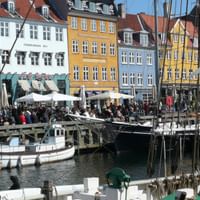
The colorful gabled houses are the heart of the city and a popular meeting place. The oldest house on the Nyhavn canal is No. 9, which was built in 1681. Hans Christian Andersen also lived here. The city's landmark, the Little Mermaid, was created by Hans Christian Andersen.
Copenhagen captivates visitors with its exciting architecture, numerous green spaces, and a clean harbor where you can even swim. Other highlights include the many gourmet restaurants and excellent bike paths. Copenhagen is a diverse city, and each district has its own special characteristics. From the Bridge District to Vesterbro—the hippest district—the city is young yet steeped in history.
- Frederiksberg is a quiet, green oasis very close to the city center.
- Vesterbro used to be a red-light district and is now Copenhagen's trendy neighborhood with funky bars and young, up-and-coming restaurateurs.
- Nyhavn and the city center are home to the royal palaces, monuments, the harbor, and, of course, the Little Mermaid.
- Nørrebro is a multicultural neighborhood where life pulsates day and night.
- Østerbro is home to Copenhagen's largest park.

Copenhagen Cycle highways
Copenhagen is world-famous for its cycling culture and is now officially the world's first “Bike City.” The new Cycle Super Highways are recognizable by their orange markings. Additional features include air pump stations, specially converted intersections, and traffic lights that are synchronized with the speed of bicycle traffic, thereby reducing the number of stops.
Last year, it was also voted “Best City for Cyclists” and “Best City to Live In.” The Danes are famous for their love of cycling, and Copenhagen, with its 390 km of cycle paths, is a “cycling paradise” for cyclists. A new network of cycle paths connects Copenhagen with the suburb of Albertslund, 22 km away. This route is the first in a planned network of 26 cycle superhighways with a total length of 300 km. A total of 22 municipalities in the greater Copenhagen area are participating in the project. These measures are intended to attract even more commuters and tourists to cycling.
Climate protection Copenhagen
Copenhagen aims to become climate neutral by 2025.
Since 2009, Copenhagen has been working on a plan to make the city greener, smarter, and CO₂-neutral in order to create a higher quality of life. By 2025, Copenhagen's electricity and heat production is to be based mainly on wind, biomass, geothermal energy, and waste recycling.
The question now is whether this can be achieved by 2025. The answer is YES, it will work, Copenhagen is consistently adhering to the strategy. Decisions are only made in line with it. As a result, Copenhagen has already reduced its CO₂ emissions by 42% (1 million tons) between 2005 and 2017, even though the city grew by 20% during the same period. However, to be climate neutral, Copenhagen must reduce CO₂ emissions by a further 1.5 million tons. The new biomass power plant in 2020 will be a major step forward. This will make 80% of district heating in Copenhagen CO₂-neutral. Climate neutrality will be achieved as early as 2023, and Copenhagen could even be CO₂-negative by 2025.
Funen
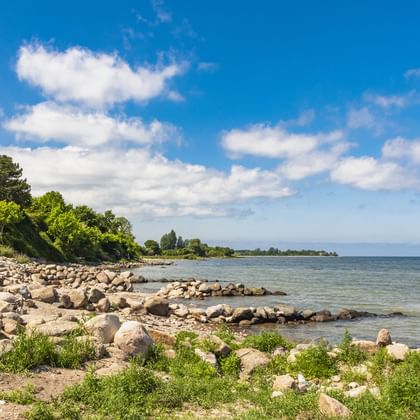
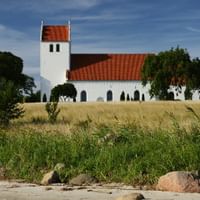
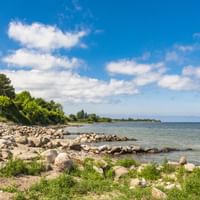
Funen is Denmark's fourth largest island and rich in glorious history. It has plenty of water, miles of beaches, steep slopes, dunes, archipelagos, and harbors. Inland, you can experience green spaces, forests, streams, megalithic tombs, landscapes dotted with manor houses, and beautiful village churches.
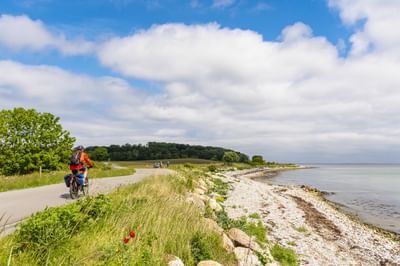
Many signposted cycle routes await you on Funen. Look out for the blue signs that guide you through areas with little traffic. A new experience awaits you around every bend. Cycle past former dairies that now operate as microbreweries. Admire the beautiful orchards and cafés and ride past the proud manor houses and castles. On two wheels, you can experience the cultural and natural highlights of Funen in a particularly impressive way.

Aero
The romantic, traditional island of Aero is an 88-square-kilometer Baltic Sea island in Denmark. Here, everything revolves around the unique natural landscape, surrounded by the South Funen Sea with its wild cliffs and wide bays. There are also historical sites and plenty of attractions away from the hustle and bustle. The name Aero comes from Danish and literally means “maple island.”
The island is ideal for a cycling vacation, but it is rather hilly. There are three signposted cycling routes that take you around the entire island and all its sights over a distance of approximately 60 kilometers. On small side roads, you can get to know the unique island landscape, follow the coastline with great views of the surrounding sea, or simply stop off in one of the small, tranquil villages.

Langeland
Here, the soul can keep up. Fantastic sandy beaches, green landscapes, wonderful dunes, fertile plains, fascinating cliffs, and idyllic harbors give the island a very special charm. The combination of approximately 120 km of coastline, an incredible number of different sights, and an average temperature of 25°C in the summer months make the island perfect for a cycling vacation.

Interesting facts about Denmark
Food culture
This is what food tastes like in Denmark
Every country has its own culinary culture, and Denmark is no exception. It's not hard to guess that this beautiful country on the North Sea and Baltic Sea specializes in fresh fish dishes. But there's also a lot more for newcomers to Denmark to consider when they start exploring the country's culinary delights.
Breakfast
The day begins with a sumptuous breakfast called Morgenmad. The bakeries (called “Bageri”) offer a wide selection of baked goods, attractively displayed in wicker baskets. Sweet pastries tempt customers in the shop window, and a large pretzel hangs above the door as a distinguishing feature of the bakery. Unlike many bakeries in our region, bageris in Denmark often still bake their own goods. You can savor this difference on your tongue. Do you like the classic white roll? In Denmark, this “rundstykker” is often sprinkled with blue or white poppy seeds. Perhaps not quite as typically Danish, you can also buy rye rolls or wholemeal rolls in well-stocked bakeries.
Fresh fish for lunch
After such a sumptuous breakfast, you could probably skip lunch, right? But the fresh fish on offer at lunchtime is tempting, and this is where Danish cuisine really comes into its own. The Frokostteller is a great choice, consisting of a colorful array of maritime delicacies. For example: pickled herring, crab, smoked fish fillets, bacon, liver pâté, eggs with mayonnaise, or roast beef, all garnished with various vegetables.
Relaxation with coffee and cake in the late afternoon/evening
A sumptuous breakfast. A fish dish for lunch. Now all that's missing is an afternoon coffee break. And here again, the bakeries have delicious cakes to offer. Starting with Wienerbrod. This consists of almond flakes, pieces of puff pastry, sugar, cinnamon, chocolate coating, and vanilla cream. Of course, Wienerbrod is also a delicious breakfast treat.
Dinner
The Danes couldn't be more different. One eats a piece of smørrebrød and the other a whole breakfast plate. Depending on what you feel like, there's something for everyone.
How about a cycling vacation in Sweden?